
 In the five minutes it took to pick up your morning coffee, the world generated more data than existed in the entire year 2000. Between 2010 and 2025, data soared, multiplying nearly 90 times over, according to IDC. The trend has split companies into two categories: those that are overwhelmed by data and those that have figured out how to turn new data and data types into an asset.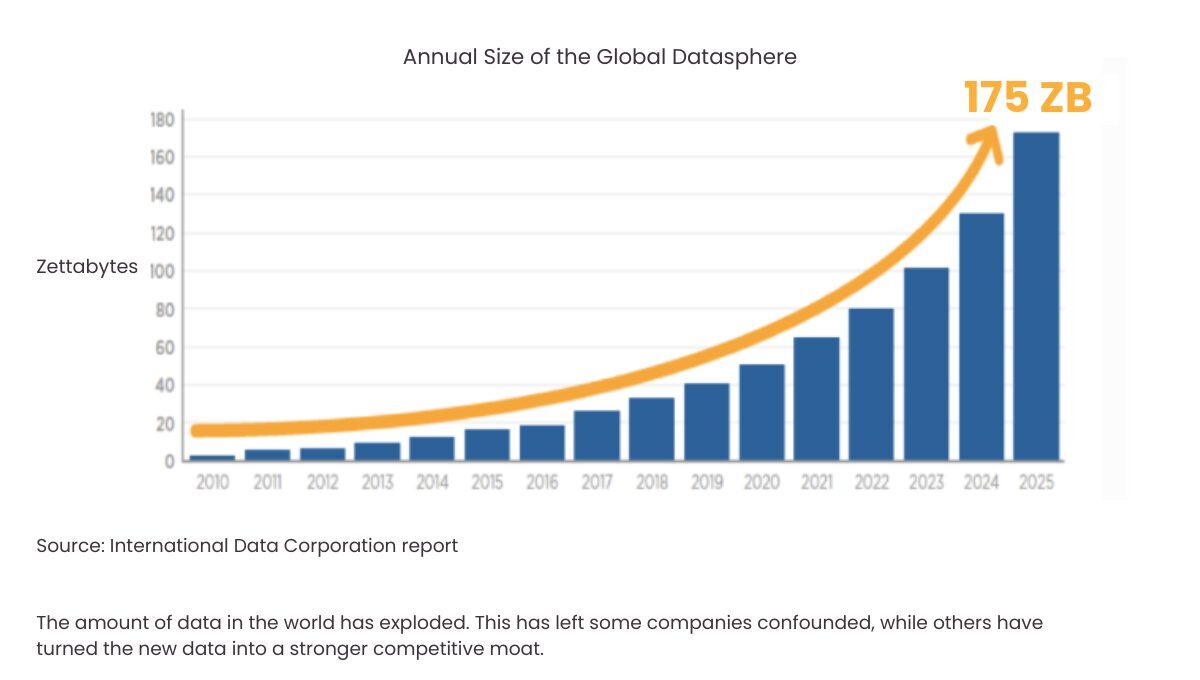
Financial institutions mainly fall into the first category. That’s because many still use, or are in the process of modernizing, legacy systems and detached data sources. A 2024 Deloitte study found that American banks spent more than $5 billion on data initiatives. Yet the majority of bank leaders surveyed struggled with data retrieval (92 percent), found their data to be poorly integrated (88 percent) or found that available data was of poor quality (81 percent).
In the AI era, effective data management isn’t simply a nice-to-have; it’s a major competitive advantage. Leading financial organizations find new use cases for AI every day – in areas like fraud, automated portfolio management and hyper-personalization. But the outcome of any AI program depends on the quality of data fed into its models. A company that can’t efficiently retrieve or integrate data won’t be able to effectively deploy AI.
While new foundation models and slick customer-facing AI products may always grab headlines, FTV Capital Partner Brent Fierro believes the companies that ultimately win in financial services will be those that simplify the migration, aggregation and utilization of large datasets in fulcrum areas like the middle and back office.
We spoke with Brent about those overlooked areas of financial services and why the best companies view data not simply as an input but also as a strategic asset.
Why is it so important for financial institutions to have a single source of data truth?
It’s always been a challenge for financial institutions to organize, consolidate, aggregate, cleanse and use different types of data. They’re highly regulated, and it’s vital to avoid data sprawl for compliance and regulatory purposes.
But along comes AI, and the stakes get even higher. What made a financial technology platform like Enfusion, our former portfolio company, so pioneering was that it was an end-to-end, multi-tenant SaaS solution that had seven or eight point solutions simplified into one integrated system and built on a single data layer. For hedge funds and asset managers, this construct allowed it to become the single source of truth, drastically reducing total cost of ownership.
Before this, hedge funds and asset managers had significant data reconciliation issues – an accounting system had to send data to a portfolio management system, which then sent to an order management system and so on. There could be many points of breakage. And for each potential breakage, a third-party fund administrator or internal employee had to sift back through to see what the problem was. It was one of the “aha” moments we had with Enfusion. With one source of truth, there aren’t these reconciliation or data communication issues, and everything can be integrated and seamless.
In financial services, where is it hardest to create this type of unified data layer?
One good example in asset management is working with illiquid or private assets. When there’s a publicly reported price or an asset is traded on an exchange, there’s more data standardization and structure built in. Private assets add an element of opacity.
Let’s say a wealth management firm has significant unstructured data points flowing in. For instance, someone wants to see the valuation of their 1970 Ferrari, alongside the valuation of a Monet, coupled with private equity investments, hedge fund investments and pieces of property.
Here’s where a company, again, needs one clean, accurate source of truth in the middle and back office, long before it can run complex analyses on portfolio management or reporting. This is exactly the problem wealth tech company Masttro (another FTV portfolio company) solves, accessing information from more than 600 custodians and pulling it into one aggregated, secure system.
Let’s say a Masttro client wants to slice and dice data for risk or portfolio management: What is my total concentration in technology assets across public and private investments? Or non-U.S. assets? Or anticipated tax burden upon wealth transfer for the next generation? Those questions can’t be answered, and you can’t run any sort of AI-powered analyses, unless you have an accurate data layer like the one Masttro creates.
We looked at the way Masttro is solving the data problem – by simplifying the middle office – and we sought out other companies that were solving it in a similar way across different verticals and markets – capital markets, insurance, banking, real estate, etc.
Let’s unpack that. How are larger financial services companies winning at data management?
Think about the sheer amount of data inside a company like Bank of America. It can draw on deposit records going back decades, trading data, historical branch data with regional nuances, the list goes on. But the challenge for Bank of America is figuring out how all this information comes together to predict spending trends or capital market movements in the current quarter.
Given our experience in data management and analytics, we began looking for companies that helped enterprises turn disparate data types, both internal and external, into one single source of truth. With accurate and vast arrays of data in hand, you can run complex analytics (cash management, scenario planning, stress testing, etc.), push structured data into Snowflake or Microsoft’s Power BI tools for visualization, and finally into trading systems for hedging and balance sheet management.
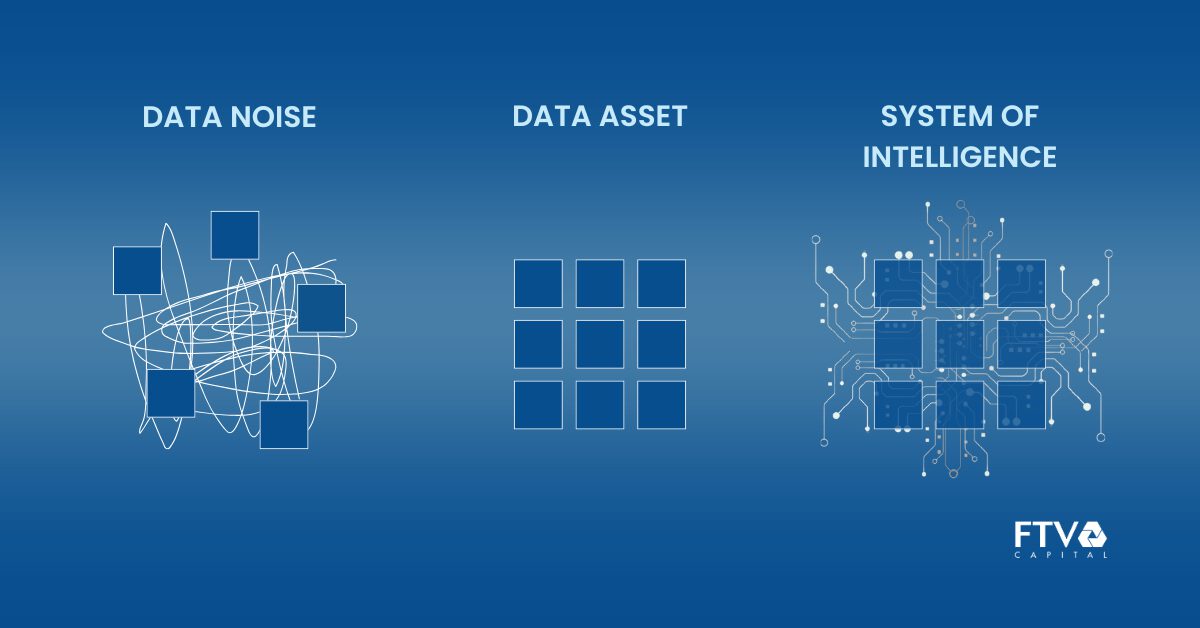
Systems that utilize and strengthen data as an asset for enterprises help empower other downstream systems and users to make better operational decisions – essentially these businesses utilize data as a “system of intelligence.”
One of our portfolio companies, Zema Global, is built for turning the big-data problem into a mission-critical application for energy and commodities companies, leveraging more data sources than anyone else in the market to power business applications and decisioning. The entire Zema Global workflow becomes critical for organizations, since it can take a middle-office data challenge, push cleansed and structured data to the front office (to traders, CFOs or senior management) and help these employees make more accurate, actionable decisions.
The data challenge in the energy and commodities sector has increased exponentially. So it’s essential to help huge organizations like Bank of America, Chevron, NextEra and many other large enterprises access thousands of discrete data points to make better and faster data-driven decisions, or power complex trading and hedging models.
Where do you believe AI is adding the most value in financial services right now?
The better a company’s data, the more easily it can take advantage of AI tools and capabilities. No need to make a bet on which model will be the winning model or how AI agents will change the way your team does business in the future. Your team can start using AI applications now on top of organized and cleansed data to improve operational functions and decisioning with these tools. Our portfolio company Windward offers a great example. Windward aggregates millions of datapoints to power its AI-driven, maritime intelligence platform. The company’s value proposition is predicated on its ability to aggregate, cleanse and integrate both proprietary and third-party data.
The output of AI models is more data, which in some cases can exacerbate a data challenge with a circular, compounding effect. The more a company’s internal systems and workflows become data consumers at scale (again, transitioning to viewing data as an asset class and system of record), the better chance the company has at engaging with AI.
If you could offer one piece of data management advice to financial services entrepreneurs right now, what would it be?
The right systems to help manage data transformation are more important than entrepreneurs think. Those systems feed into other mission-critical applications that then create a data asset out of what was previously only data noise and confusion. The right focus and execution can then turn these enterprise data systems of record into full enterprise systems of intelligence to help power operational decisions – portfolio management, risk management, trading, hedging and so on. Focusing on getting the data layer right will set up your business to consume tremendous amounts of information in a faster-paced, AI-powered world.
Recent Insights
- In Focus
- Think Forward
- FTV Bylines